Ensor’s whimsical vegetables

Article by Herwig Todts
I have made a few comic etchings. I always throw myself from one extreme into the other and I am still waiting for the inspiration to paint. The desire to paint has become somewhat dulled but (…) that desire will certainly return.
Summer of 1896
Only in the summer of 1896 does Ensor start working again. He has found a new style, about which he writes: ‘in my latest paintings I am preoccupied with other issues, and they are not interesting because of their noble tonality or their delicate atmosphere.’
Ensor is referring here to still lifes. They were rarely used by artistic innovators to develop new modes of representation. Except around 1900, when artists such as Van Gogh, Cézanne, Picasso, Braque or Matisse were experimenting intensively with the still life.
For Ensor, too, the still life proved to be the ideal genre for experimenting with new pictorial questions. Roughly a third of his oeuvre consists of still lifes. As a critic of other artists’ work, he believed that the still life was the touchstone of the true colourist.
Still lifes in ‘a new manner’
For his new style he repeatedly uses the same console table with a white marble top, placed in his attic studio close to the large window. The perspective lines of the tabletop reveal Ensor’s position while painting — seated or standing at the easel. At times he arranges two Chinese vases and bouquets of wildflowers; at other times objects from the Far East, a nude Venus, a painter’s palette and a shell surrounded by carnival masks. On a third occasion he chooses vegetables that were not yet commonplace in the Belgian kitchen at the time, such as tomatoes, rhubarb, gherkins, an artichoke, a turnip and endive.
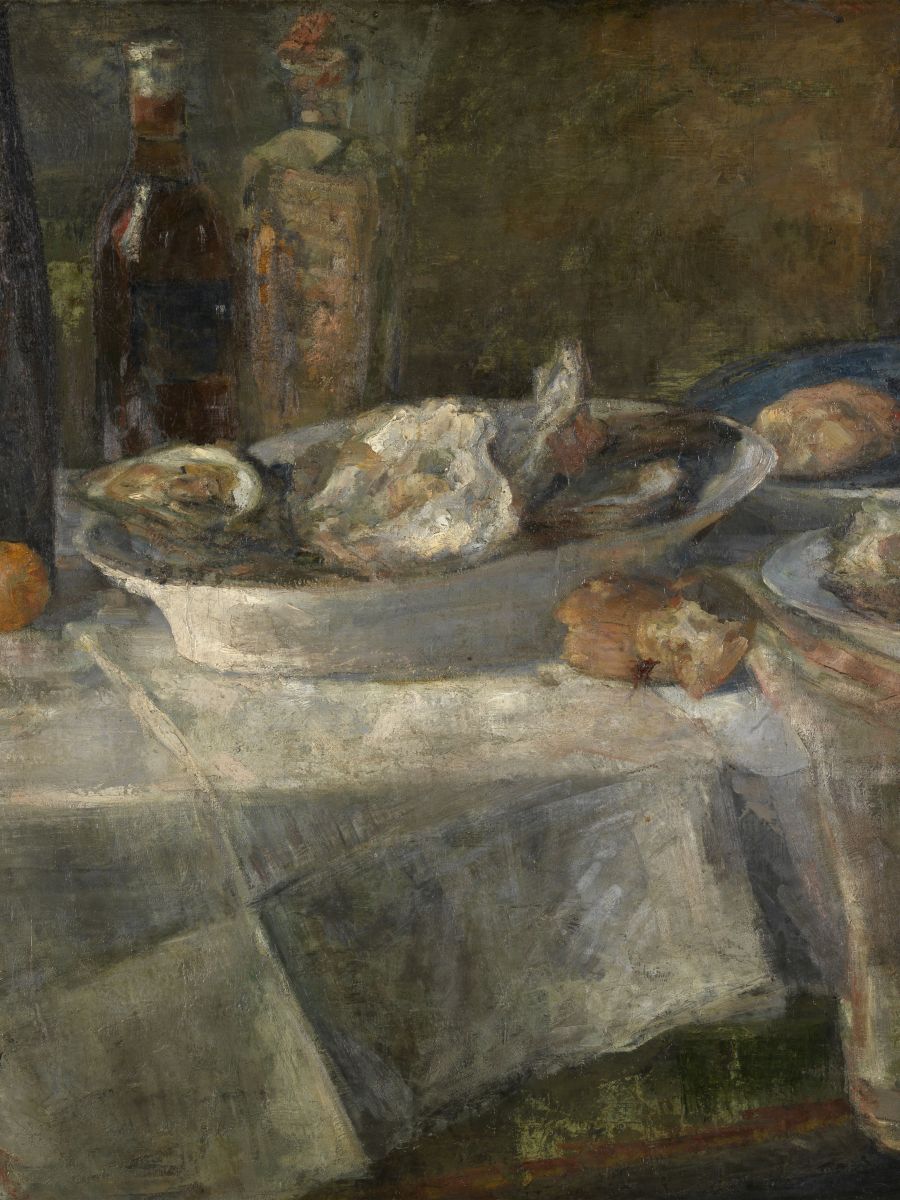
Still Life with Oysters, 1882 - James Ensor
Sinuous play of lines
In the work Flowers and Vegetables, strong contrasts of primary colors immediately catch the eye. The bright yellow of the sunflower against the sky-blue vase, and the deep ultramarine of the decorative motifs on the German beer stein; the deep red, slightly purplish stems of the rhubarb against various shades of green. The orange-red tomatoes (or small pumpkins?), the cherries, and the hard-to-identify red flowers seem to compete for attention.
The sinuous play of lines in Ensor’s whimsical vegetables becomes even more evident in an infrared image (from the Ensor Research Project). In the underdrawing, we can recognize the tabletop and the vegetables, which immediately reveal how Ensor began this still life. The infrared image also shows a third vase with a narrow neck to the right of the sunflower, which Ensor later painted over. A cupboard eventually transformed in the composition into a green curtain.
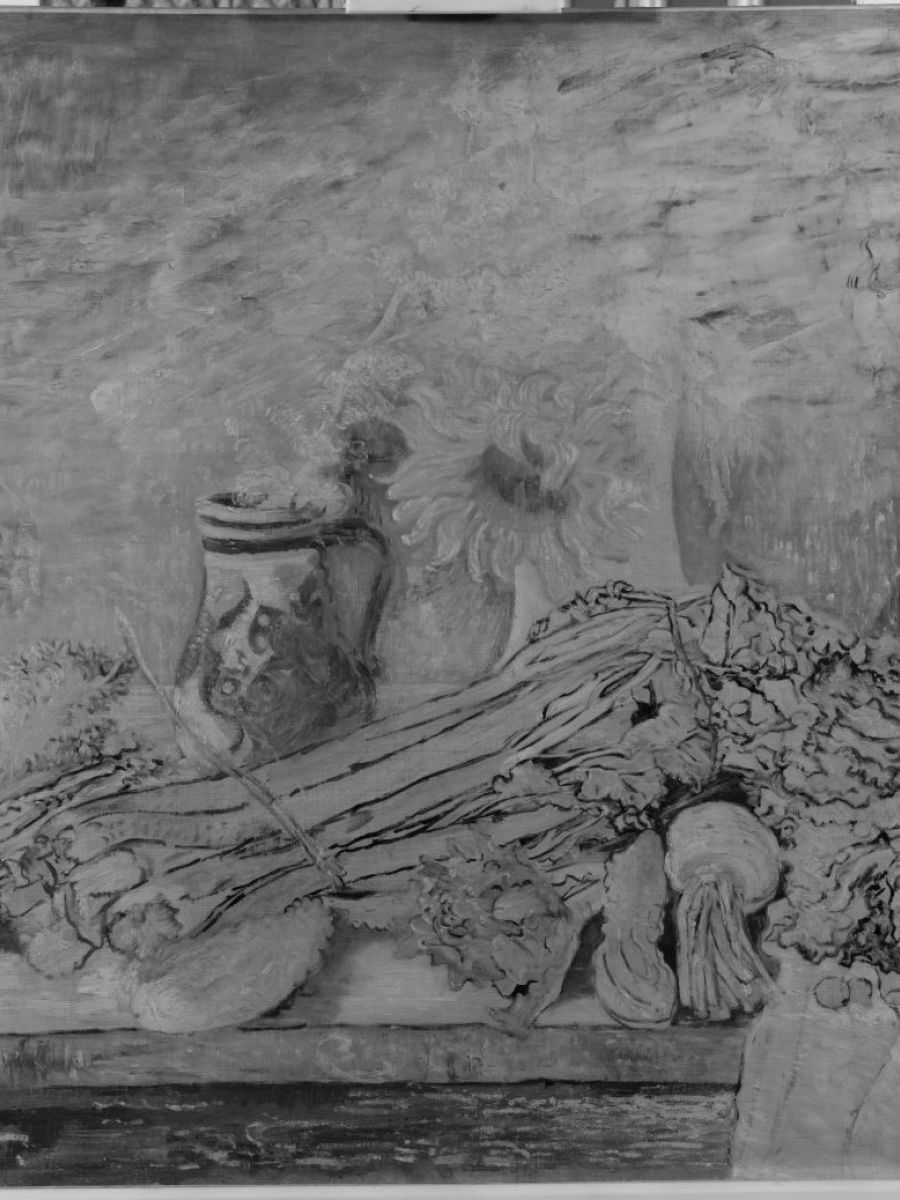
Infrared image of Ensor’s Flowers and Vegetables (detail)
Background information
Ensor sold the painting to Mariette Rousseau. In a letter dated 19 October 1896, he apologizes for the delay in delivery. The reason: retouching an area above the painted-over vase. That area seems to have been significantly altered. The exact issue can only be guessed. The indistinct world behind the table appears to Ensor to be at least as important as the vegetables on their stage. Especially in his later still lifes, Ensor playfully involves the background in animating seemingly simple compositions. During these experiments, he truly found a new path.
With thanks to Annelies Ríos-Casier and the colleagues at the Botanic Garden in Meise.