Restoring feels like going on a journey

The yellowed varnish layer all but negated Ensor’s intentions: all the subtle nuances in his colours were obscured, and the glossy varnish created distracting reflections. Finally, the lively surface texture that is so characteristic of the painting had also disappeared. Thorough research followed by restoration allows the work to shine again in the way Ensor had intended.
For her master’s thesis in Conservation–Restoration at the University of Antwerp, Annelies Ríos-Casier delved into the various layers of James Ensor’s iconic work, using highly specialised imaging techniques. Lene Smedts set to work on the layers of varnish and paint. Together, they answer all the questions about Ensor’s kitchen secrets and the effects of restoration. A conversation in layers.
In fact, that varnish layer acts like a yellow filter over the painting. Compare it to wearing yellow-tinted sunglasses: the filter gives all colours the same yellow cast. The original colours can no longer be seen as they truly are.
Layer 1: varnish
By removing a yellowed varnish layer, The Oyster Eater looks much more vibrant. Why does a yellowed varnish make such a big difference?
Annelies: “In fact, that varnish layer acts like a yellow filter over the painting. Compare it to wearing yellow-tinted sunglasses. That filter gives all colours the same yellow cast. The original colours no longer come into their own.”
Lene: “In this work, there were even multiple layers of varnish. In the past, ‘refreshing’ a painting often simply meant applying a new varnish layer. But beneath that layer there was also a grey filter of dirt. By removing all the filters, the entire colour experience changes.”
Is it wise to apply a new varnish layer after restoration?
Lene: “Yes, mainly because research shows that James Ensor did this himself. Restoration serves the artist’s work; we do not introduce changes of our own. A varnish layer has the advantage that, after all the adjustments, you apply a homogeneous layer that unifies all aspects of the work. The varnish also has a protective role, meaning it is less likely to become damaged.”
Each varnish layer has its own level of gloss. As a conservator, you can respond to that. A natural varnish suits The Oyster Eater. The effect is more saturated colours and greater contrast.
Moreover, conservators today no longer work with very thick layers. Instead, they apply thin layers, so that yellowing becomes less noticeable over time. Another factor is that the work is kept in a museum context: UV rays and other harmful radiation are kept out as much as possible, which slows down the yellowing process.”
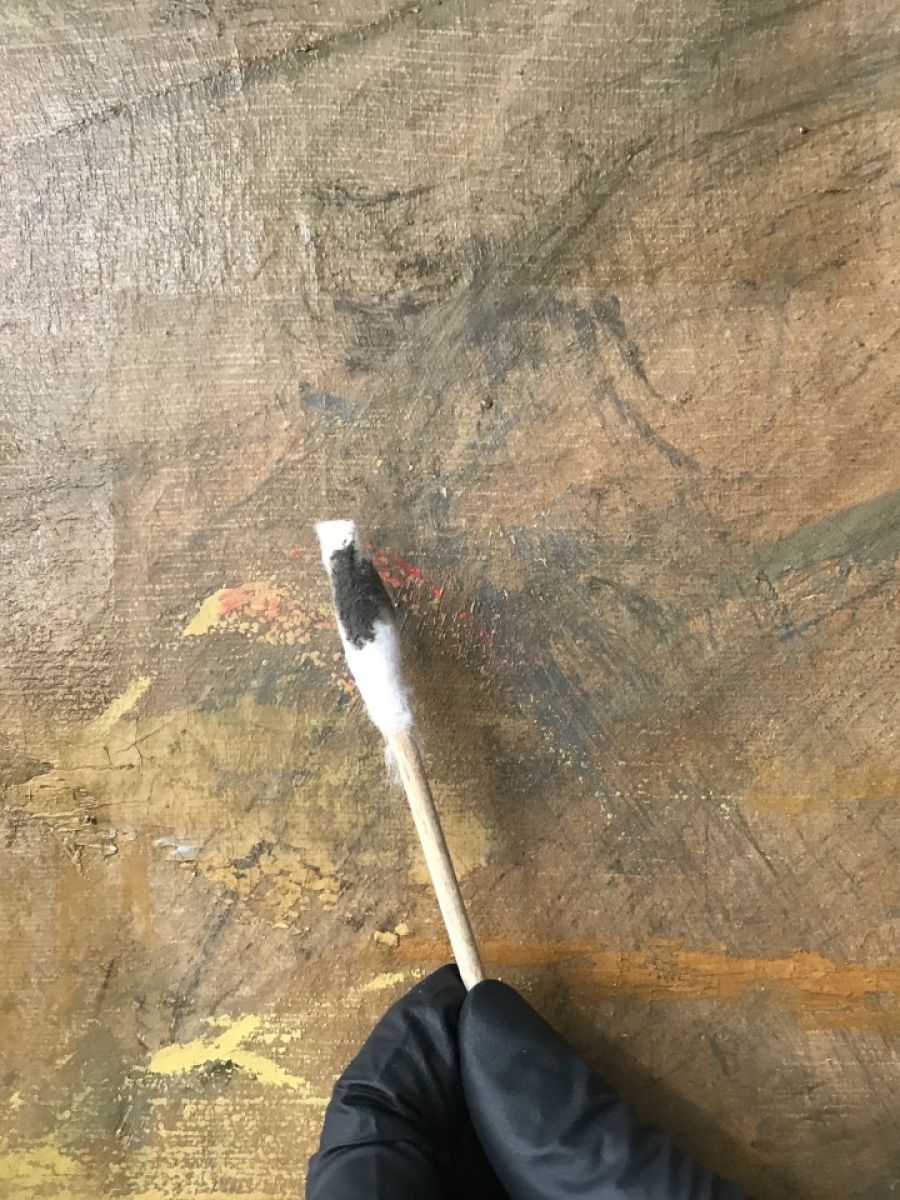
Dirt on a cotton swab shows the importance of removing the varnish layer.
Layer 2: the paint surface
How does The Oyster Eater differ from Ensor’s earlier works, such as The Bourgeois Salon?
Annelies: “I see The Oyster Eater as an experiment by the artist. The earlier The Bourgeois Salons are darker because James Ensor mixes his paint with dark earth tones. That mixing makes the whole composition somewhat softer, like an old photograph. In The Oyster Eater, he uses pure paint for a lighter and more intense effect. Everything is in contrast with each other. At the same time, he leaves a very large area sketchy, which you see less in his other paintings.”
Lene: “With an artwork, the experience is important, and with a large painting like The Oyster Eater, it’s a real experience. Ensor chose his colours deliberately. Every colour has a purpose. They all contribute to the overall experience.”

The Bourgeois Salon - The colour difference between The Bourgeois Salon and The Oyster Eater is striking.

The Oyster Eater - James Ensor
How do you explain that difference in colour?
Annelies: “Artists knew the qualities of traditional pigments—how they aged and whether they were stable. In Ensor’s time, new pigments and types of paint suddenly appeared on the market. Artists were initially quite hesitant to try them out. Letters show that this concerned Ensor as well, particularly the stability of these new pigments. They were cheaper and more vivid, which opened up new possibilities.
In The Oyster Eater, Ensor largely sticks to his traditional pigments—except for yellow. Previously, he used pale Naples yellow or the brownish ochre yellow. Compared to other unmixed colours, like the bright vermilion red, these yellows were not strong enough. That is a good reason to choose the new chrome yellow.”
Does Ensor experiment with anything besides pigment use?
Lene: “Ensor knows and masters the way light interacts with the different paint textures of the painting. He plays with smooth and rough surfaces, with opaque and transparent areas. In the other The Bourgeois Salon, the surface is painted densely. By restoring the work, you can once again see how deliberately Ensor builds up his paint. The Oyster Eater is a very interesting work to study because it contains all these different elements.
As a conservator, you also work tactically. You are directly engaging with the physical material that the artist manipulated with fingers, palette knives, and thick and thin brushes.”
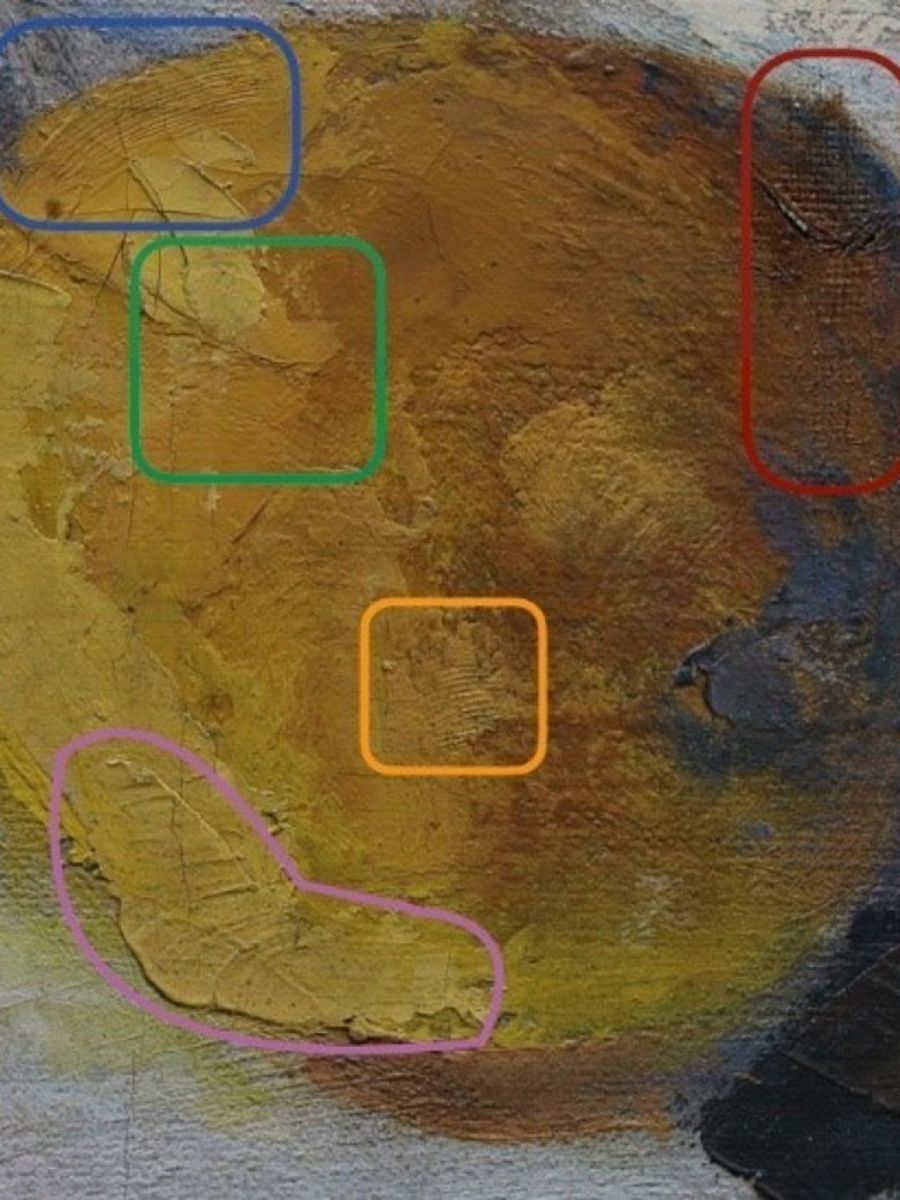
Brushes, palette knives, and his thumb. Ensor used a variety of tools to paint The Oyster Eater.
Layer 3: within the paint
Are there other aspects typical of a modern artwork?
Lene: “All layers consist of different chemical components. A layer of paint may seem dry and static, but beneath the surface and between the layers, many chemical reactions are taking place!
Oil paint continues to dry for a very long time. In The Oyster Eater, the paint layers are still in the process of drying, making them much more sensitive to solvents and restoration treatments than 17th-century masterpieces that have been drying for 300 years. In modern art, the layering is often limited, so generally there is less leeway during restoration.
Every artist explores within their own oeuvre how they handle the development of new paints and techniques.”
Annelies: “That’s what I find so interesting about modern art. It feels to me that a lot of research has already been done on older art. With modern and contemporary art, a new problem arises every day. Artists use materials in individual ways and create their own challenges. There are always new discoveries, new stories.”
Lene: “Modern art is still young, and so are the aging processes. In restoration, I always try to be cautious. Sometimes you face questions that don’t have immediate answers. Restoration is therefore also a search for clarity. You have to take your time before taking any major actions and consult with colleagues.”
Craquelure is a natural aging process. The drying process of paint can stretch over more than a hundred years and never stops. As paint dries, part of the wet material evaporates. The composition of the paint changes, the paint shrinks, creating tension. What does paint do under tension? It cracks.
The Oyster Eater proves to be sensitive to cracks in the paint, also known as craquelure. How does this craquelure develop?
Lene: “Craquelure is a natural aging process. The drying process of paint can stretch over more than a hundred years and never stops. As paint dries, part of the wet material evaporates. The composition of the paint changes, the paint shrinks, creating tension. What does paint do under tension? It cracks.”
Annelies: “In this work, the cracks are mainly colour-related and appear in the white, dark blue, and dark red areas. Dark colours like blue contain a lot of oil, which easily causes shrinkage cracks. A paint layer that is too thick can also produce craquelure.”
Lene: “Then there is something called mechanical craquelure. If the canvas receives a knock, it can create spiderweb-like craquelure. You also see this in The Oyster Eater. Wind along the back of the painting during transport is dangerous; the canvas can start to flap. The size of the canvas (153 × 210 cm) makes the whole work fragile.”
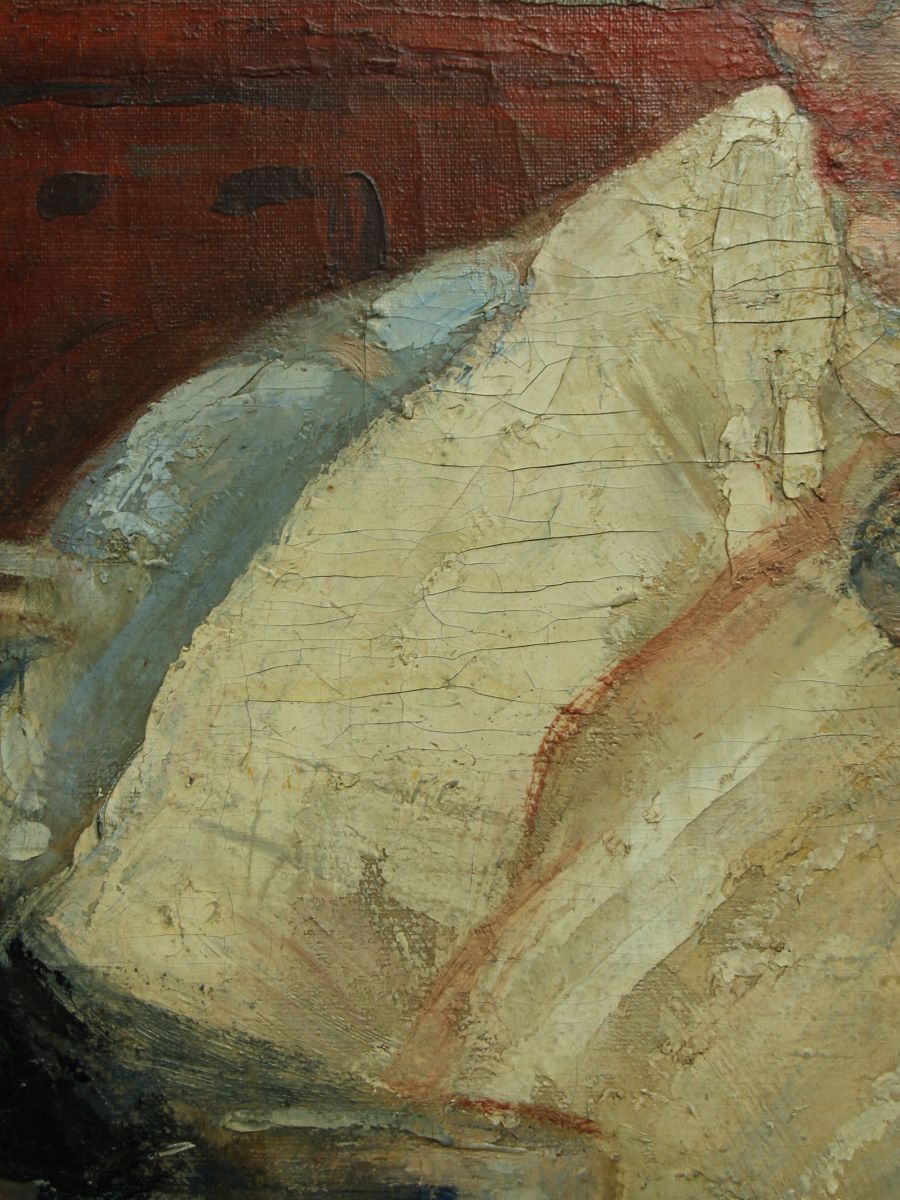
- The craquelure is most pronounced in the white, dark blue, and dark red paint layers.
Layer 4: behind the canvas
How do you protect a work from new craquelure?
Lene: “For this treatment, an insert lining with a backboard was placed on the back of the canvas. This polyester panel is mounted on the rear of the painting. It fills the gaps between the stretcher frame, on which the canvas is stretched, and the canvas itself. The canvas can move less, so a blow will cause less damage. It absorbs vibrations during transport and protects against dirt. The backboard also acts as a climatic buffer.”
Layer 5: underlayers
Metal soaps have also been found on the canvas. It was decided not to remove them. What are metal soaps, and what problems can they cause?
Annelies: “Metal soaps form through a reaction between a metal-containing pigment in the paint and the paint acids in the oil binder. When these react, a small bead forms, also called an agglomerate. If the reaction continues, the bead can grow through the paint layer. When multiple metal soaps appear close together, it can look as if there is a crust of sand on the paint surface. Beads can even fall off the canvas. In The Oyster Eater, the metal soaps are not colour-related, so we suspect the cause lies in the ground layer, which contains lead according to specialized scans. Fortunately, they are very limited in occurrence, and no action is required at this time.”

Annelies only noticed the metal soaps under the microscope. To the naked eye, the beads are barely visible.

Annelies, you created a dummy for your master’s thesis to test your ideas about Ensor’s use of a ground layer. Why?
Annelies: “I made a model to test the difference between painting on a white ground versus a tinted underlayer. Contrary to my expectations, the effect wasn’t that significant. A coloured underlayer ensures that the colours are more harmonized, forming more of a unity. It gives the painting a warmer glow.”
Which ground layer did Ensor use in The Oyster Eater?
Annelies: “I think Ensor used a beige underpainting, but Lene thinks it might not be there after all.”
Lene: “The difference between a white and a lightly coloured underpainting is minimal. Moreover, Ensor often paints opaquely. For the restoration, it made little difference because the focus was on varnish removal and cleaning.”
Anelies: “The area at the lower right was left sketchy and transparent. There, you can see the beige underpainting showing through, intended to break up the white. Layer analysis could provide a definitive answer, but that would require taking a sample. We try to avoid that, as it is a destructive procedure.”
And so there is always something left to investigate. But wouldn’t you rather restore, Annelies?
Annelies: “It has always been my great passion. Right now, I’m at a bit of a crossroads: should I go for pure restoration, or focus on research? At the moment, I lean more toward research because I love learning. I enjoy studying and solving difficult chemical problems. A fantastic challenge!”
Lene: “For both of us, it’s a journey. In our different fields of work, there are many questions we don’t have immediate answers to. In the end, it’s just another part of the same puzzle. It’s always about continuing to learn.”
With thanks to...
The Oyster Eater by James Ensor was restored thanks to the support of the Baillet Latour Fund.