Small and big adventures at the KMSKA

Recently, Siska Beele, 19th-century curator, retired. Well, sort of. Because Siska continues to contribute to the KMSKA. As a guide, for example. This brings things full circle, since Siska first came to the museum when she applied for a freelance guide position. As a young public engagement officer, she was already organizing exhibitions, and as a curator, she paid close attention to the visitor experience. For the museum’s reopening, she developed the new presentation of the 19th-century works. In the meantime, she advocated for greater visibility of women artists. A 40-year career deserves a “farewell interview,” even if it’s not really a farewell. And 40 years is too long to capture in a single interview. Still, we make a modest attempt.
How did you end up at the museum?
Siska Beele: “The 1980s were years of unemployment, both for art historians and in general. In 1980, someone pointed out that the KMSKA was looking for guides. I made an appointment with Leen de Jong and Els Maréchal, who were leading the educational department. I was able to start immediately. In the meantime, I worked in various places under different temporary contracts. I taught, worked at MSK Ghent, and for Europalia Mexico. I also established a documentation center for women’s literature and women’s studies.”
Although you only transitioned to research much later, you were able to contribute to an exhibition in 1991.
Siska Beele: “In 1992, it had been 500 years since Columbus discovered America. The then-Foreign Relations department wanted to launch a project around 500 years of relations between Flanders and Latin America. Because I spoke Spanish, director Lydia Schoonbaert asked me to lend my support to this special initiative. I became the art historian alongside the historian who had already been hired. The passionate curator Paul Vandenbroeck, together with Catherine de Zegher, devised the concept for the exhibition. The scholarly team was completed by Erik Vandamme, head of the Department of Old Art at KMSKA, and two professors.”
And that became America, Bride of the Sun.
Siska Beele: “We created a truly gigantic exhibition, under circumstances we can hardly imagine today. There was no internet, no email. We corresponded with South America by phone, fax, and letter. We sent out over 1,000 loan requests to ultimately display 400 objects. America, Bride of the Sun was an absolute milestone. Beyond the historical narrative, we showcased the cultural exchange between American and European cultures. Catherine de Zegher managed to involve South American artists for the contemporary section who later became highly celebrated: David Lamelas, Eugenio Dittborn, Gabriel Orozco, Cildo Meireles. At the time, it was groundbreaking to give these non-Western artists a platform. Many of the artists involved critiqued Eurocentrism and created their work on site. The entire museum became part of this creative frenzy.”
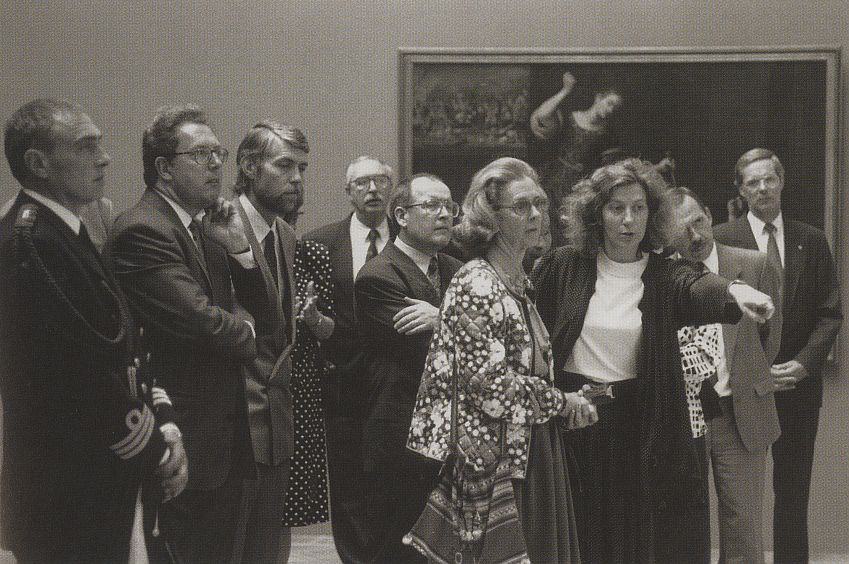
Siska guides Queen Fabiola through the exhibition America, Bride of the Sun. - Archief KMSKA
And then it was back to the educational department.
Siska Beele: “Yes, until the new chief curator, Paul Huvenne, offered me the 2000 exhibition Kinderen op hun mooist, a fantastic collaboration with the Frans Hals Museum in Haarlem. That year, I was the curator while continuing my duties in the educational department. Fortunately, I had a lot of support from exhibition coordinator Arnoud Odding.”
During the museum’s closure, you curated off-site exhibitions and tackled the future presentation of the collection. You primarily designed the Salon with its wall-to-wall hanging. How do you even begin something like that?
Siska Beele: “The 19th century is very diverse. You ask yourself: what is worthy of being hung? How can we best display the works? Criteria such as art-historical importance, aesthetic considerations, and condition come into play… A large, spectacular piece could not be missing in a presentation that aims to evoke the 19th-century salons. That piece became Spanish Fury in Antwerp by Ferdinand De Braekeleer (473.5 × 686 cm). We also have very beautiful 19th-century sculptures. I thought it was important to show those too. And not tucked away in a corner, but in confrontation with the paintings.”

The Salon layout for our 19th-century art: a spectacular centerpiece, many paintings, and the seamless integration of sculptures. - Photo: Sanne De Block

Photo: Karin Borghouts
As a colleague, we know you as an advocate for women’s rights. Where does that commitment come from?
Siska Beele: “During my university career, I was taught only by male professors. They paid no attention to women artists. It was a book about Artemisia Gentileschi, the Italian Baroque artist, that woke me up.”
How do you put that commitment into practice when the collection includes so few women?
Siska Beele: “From the educational department, we offered a tour called Women in the Spotlight at one point. It focused on women artists, how women are represented, and the male gaze.”
“From a collaboration with Gynaika came the exhibitions Elck zijn waerom (1999) and Gekooid verlangen (2007), featuring only women artists in the lead. That non-profit advocated for greater visibility of women artists and later focused on diversity. Unfortunately, it is no longer active. Even for America, Bride of the Sun, Catherine de Zegher consciously included many women artists, such as Cecilia Vicuña and Ana Mendieta. That was not straightforward, because Ana Mendieta’s work was an imprint of the artist in earth, created on site… Making that happen was one of the many smaller adventures we experienced at the museum.”

Gallery views of Gekooid verlangen featuring works by Jane Graverol and Rachel Baes. - KMSKA Archives

Is that something you consciously incorporate into your own tours?
Siska Beele: “Absolutely. I even start with it, in the staircase hall. I ask visitors what strikes them about those large paintings by Nicaise de Keyser. Sometimes an observant mind notices that the only women are fictional figures, representing, for example, the branches of the arts. In a way, I find it almost worse that people don’t realize there are no women artists among the men, than the fact that they are absent. It makes it seem as if we still assume that being an artist is a man’s domain. Yet these women do exist. It’s just that history was written by men who ignored women artists.”
Of course, in the 19th century there was a certain image of women.
Siska Beele: “Indeed. I also read a lot of 19th-century literature, like Gustave Flaubert. He was not exactly the greatest admirer of women. You see many tragic heroines. Think of Madame Bovary, who struggles with herself and her life. You find that type of woman again in Wanhopig by Alfred Stevens. Each of these women is a creation of men.
I tried to compensate for that tragic-melancholic aspect by adding the portrait of the ravishing Maria-Laetitia Bonaparte-Wyse, the seductive woman by Lourens Alma Tadema, and the more adventurous traveler by Tissot.”
“In the Salon, there are also works by three women. That’s a start. You can supplement with loans, acquisitions, and, as mentioned above, exhibitions. It would be great to add more women artists to the Salon, such as Rosa Bonheur. She recently had a retrospective at the Musée d'Orsay.”
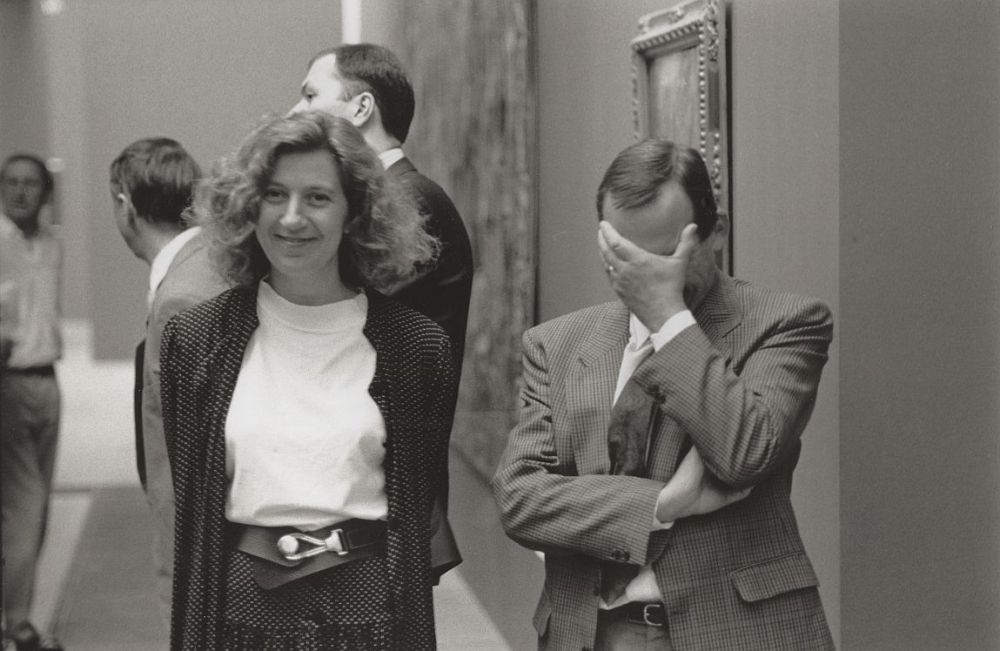
Siska with a twinkle in her eye – has she just told a little joke? - KMSKA Archives
We also know you as the encyclopedia of museum history. What, in your opinion, makes the KMSKA different from other museums?
Siska Beele: “The KMSKA was once considered a provincial second-tier museum, after the Royal Museums in Brussels. Yet here, for example, we have an enviable collection of Flemish Primitives, including Jean Fouquet, Antonella di Messina, and many others.”
“Over time, the museum has become highly professionalized. We have become a fully-fledged museum institution. In the past, everyone was a bit more all-round; now we have specialized departments for staff, accounting, communications, and collection management. Only the familial aspect has diminished somewhat. Everything was slower, but the work still got done.”

Once a guide, always a guide… with children,…

… or with colleagues during the installation of the galleries.
Are you satisfied with your 40-year career?
Siska Beele: “You always have to make choices. ‘You will always experience less than you can handle,’ my father used to say. I am very happy with my path, how I moved from education to research. Schoonbaert always said, ‘Everyone is a public engagement officer.’ She was right. You can lock yourself away and only research what interests you. But as a museum professional, you work for an audience. Diving into archives is important, but you also have to engage people.”